
NVC 2026: National Visa Center documents, step by step
National Visa Center (NVC) after I-140 approval: the $345 fee, DS-260, scans in CEAC, police certificates, the cover sheet, mail rules and sample translations.
Contents6
After NVC comes the interview at the consulate. Related guides:
Sending documents to the National Visa Center (NVC) after an EB-1 or EB-2 NIW approval
Congratulations on your approved EB-1 or EB-2 NIW petition! The approval means USCIS recognized your achievements, and you are a big step closer to immigrating to the U.S. Another important stage comes next: sending your civil documents to the National Visa Center (NVC) and going to the interview at a U.S. consulate.
What is the National Visa Center (NVC)?
The National Visa Center (NVC) in Portsmouth, New Hampshire, is the part of the U.S. Department of State that does the first round of immigrant visa processing for applicants outside the U.S. Once your petition is approved, USCIS sends your case to the NVC, where the case gets its own number. This takes a few weeks, not days. NVC posts its current pace every week on the NVC Timeframes page: on October 5, 2026, it was creating cases it received from USCIS on September 11, 2026. Then NVC e-mails you instructions with the login details for your online account, where you pay the consular fee and fill out Form DS-260 for each family member.
The immigrant visa fee for employment-based categories (EB-1, EB-2 NIW) is $345 for each applicant, spouse and children included (travel.state.gov). After the visa is issued, you also pay the USCIS Immigrant Fee of $235 per person. Until it is paid, USCIS does not send the green card (uscis.gov).
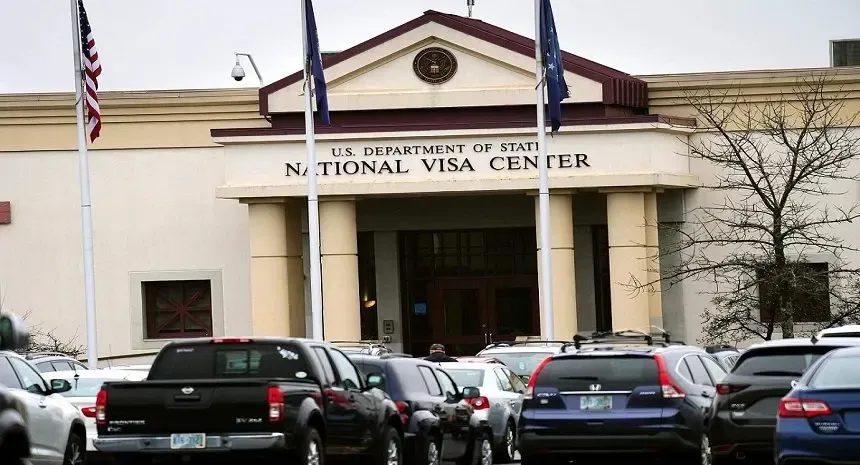
The NVC building (National Visa Center)
NVC keeps your petition and documents until your interview at a U.S. embassy or consulate can be scheduled. If the petition is for a close relative (the spouse, child or parent of a U.S. citizen), NVC starts right away. For employment-based cases (EB-1, EB-2 NIW) and the other family categories, NVC starts when your priority date becomes current, that is, matches or comes close to the date in the latest Visa Bulletin. If your priority date has not reached the cutoff date yet, NVC tells you so and waits until your date is current.
More about cutoff dates and how to check the bulletin: the official Visa Bulletin page.
https://travel.state.gov/content/travel/en/legal/visa-law0/visa-bulletin.html
Steps to prepare and send your documents to NVC
- The NVC Welcome Letter:
A few weeks after USCIS approves the petition, NVC sends you a letter with your case number, how to log in to your online account, and the fee to pay. There you fill out Form DS-260 for each family member who is immigrating with you (see our DS-260 guide, in Russian).
What the NVC e-mail says
The screenshot below shows the e-mail that NVC sends to the applicant. It says that NVC is processing the immigrant visa case and asks the applicant to read the attached instructions and follow them. It also says that the message holds confidential information, and that anyone who got it by mistake should write to NVC at asknvc@state.gov
A PDF file is attached at the bottom of the e-mail. It has the details you need to log in to the system and the next steps of the process.
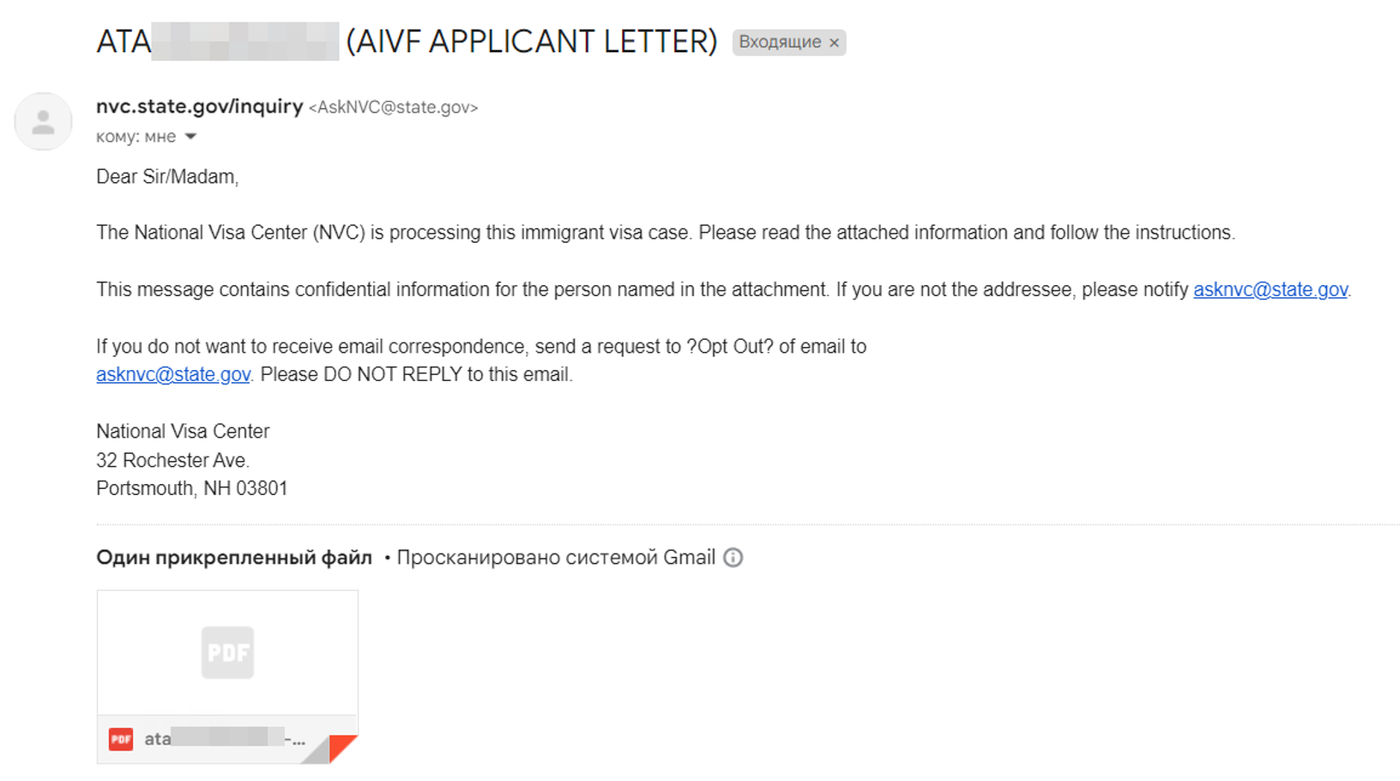
A sample NVC e-mail with the main details you need to register
The PDF attached to the NVC e-mail lists the next steps: how to pay the fees and how to submit the application and the other documents. It also explains how to send documents to NVC and what to do if you have questions.
Tracking your case status:
Use the case number from the Welcome Letter to follow your case in CEAC and get updates from NVC. If the letter has not come within 30 days, contact USCIS:
- In the U.S.: +1 (800) 375-5283
- Outside the U.S.: +1 (212) 620-3418
Sample call:
Getting past the USCIS automated system
- Applicants report that saying "InfoPass" gets you to the part of the menu for case status questions.
- If the system asks, name the visa type: "EB-1" or "EB-2 NIW" (you can spell it out: EB-1 or EB-2 N-I-W).
Asking the agent about the transfer to NVC - When you reach an agent, say: "My question is about the status of my case being sent to the NVC."
- Give your receipt number from the I-797 notice (for example, IOE 111 222 3333).
- If more than 30 days have passed since the approval, add: "My case was approved, and I'd like to check why there is a delay in sending it since it's been over 30 days."
Ending the call - Thank the agent: "Thank you, all the best!"
NVC sends login details and instructions for each family member. Check every detail carefully: last names, dates of birth and passport numbers. If you find a mistake, the letter tells you how to reach NVC. NVC answers questions in the order it gets them and posts its current response time every week on the NVC Timeframes page: on October 5, 2026, it was answering inquiries received on September 25, 2026.
If a child is born or you marry, tell NVC and send the documents to add them to the case. NVC accepts changes only with supporting documents.
Also, if you want your interview in another country, send NVC a request with documents showing that you live in that country, such as a work visa or a residence permit. The State Department asks for this proof, or for the reason you need an exception. Since November 1, 2025, NVC schedules interviews where you live or, if you ask, in your country of nationality. The rules also allow your designated processing post, if the State Department has named one for your country. For any other place NVC may ask for more details or decide whether an exception fits (State Department FAQ). Now and then a transfer goes through without such documents, but your chances are better with them.
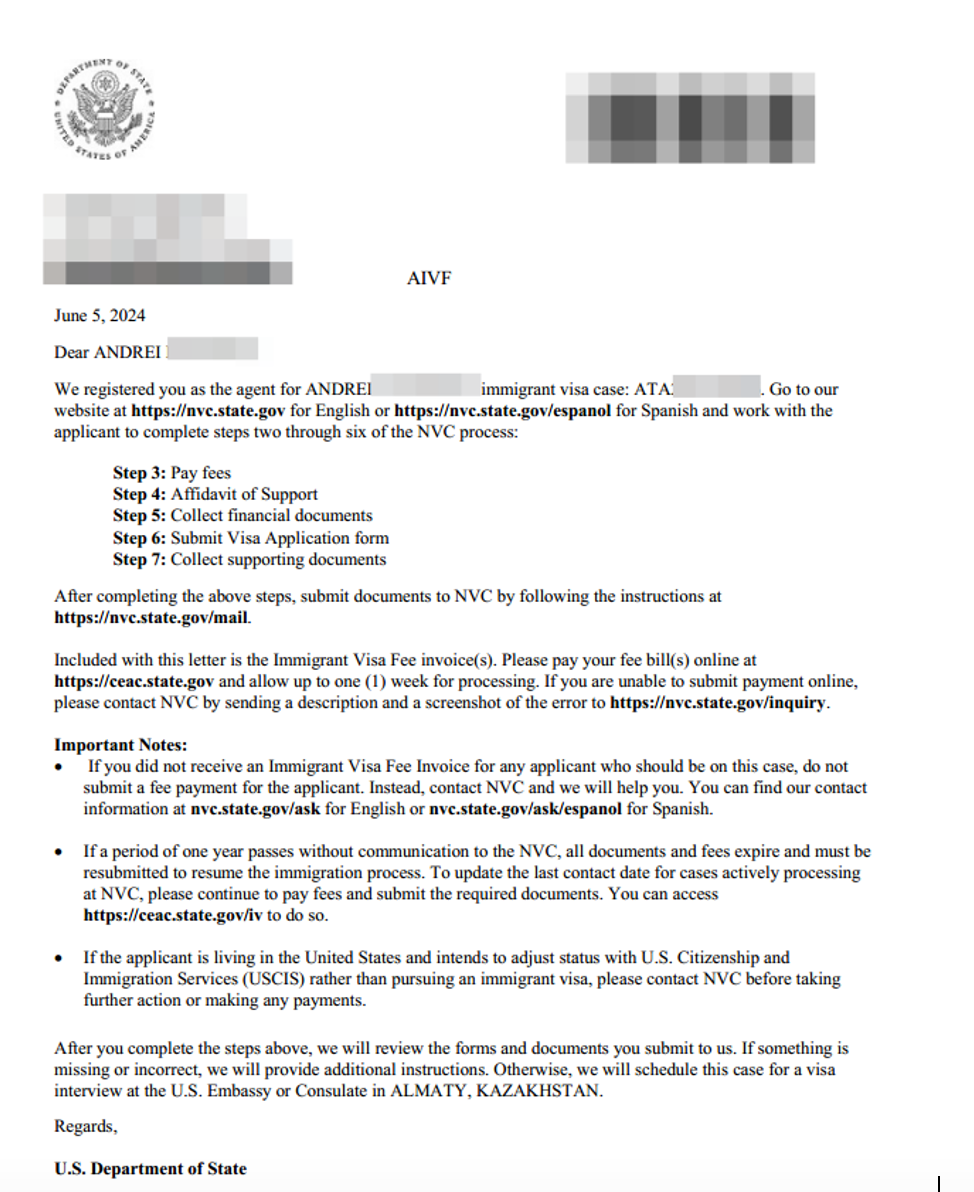
The first page of the PDF that NVC sent by e-mail
NVC gives you a new case number based on the country where you will have the interview:
Example (this is how applicants decode it; NVC does not publish the format): ATA2024659006
- ATA - Almaty
- 2024 - the year
- 659 - the day of the year the number was given, plus 500: 659 - 500 = day 159 of the year (search for "day 159 of the year" to get the date your case got its number)
- 006 - your case was the sixth one assigned to this city (Almaty) that day.
If NVC asked you to send your documents by mail, the attachment also has a Document Cover Sheet. It is one form, used for every member of your family:
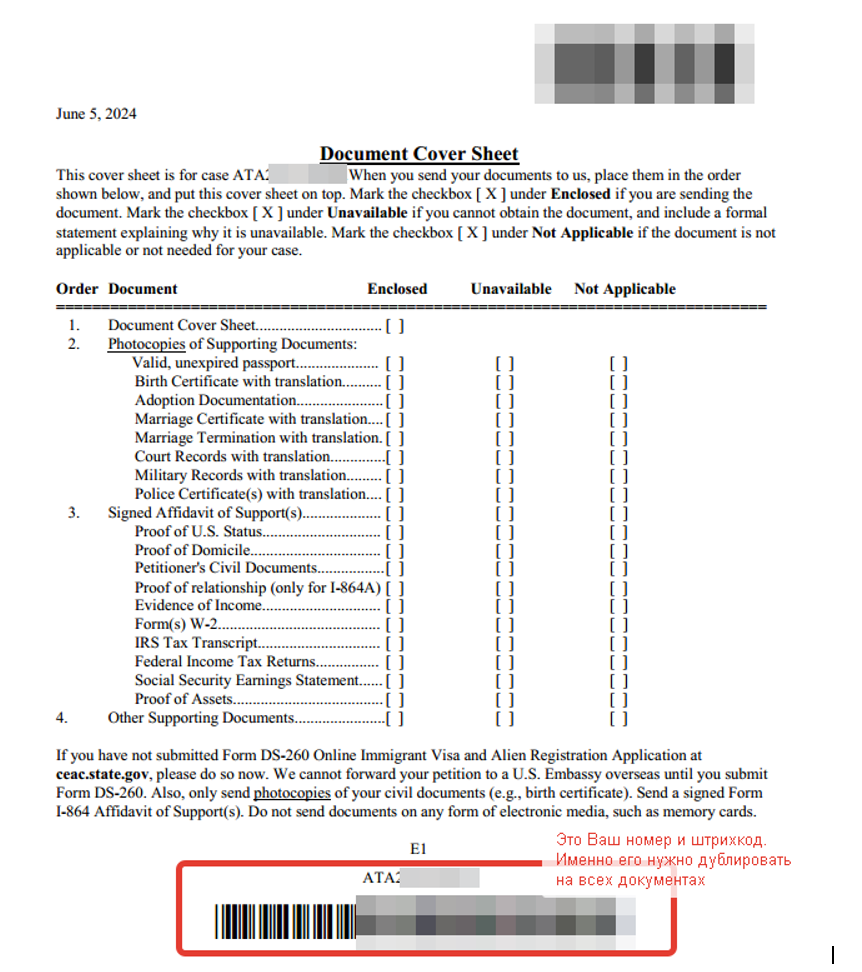
The cover sheet from NVC: one form for every family member
This page goes first in each family member's set. It has no personal details on it (you do not have to write your name on it). But you fill it out differently for each person, depending on which documents you send to NVC.
- Enclosed - the document is attached
- Unavailable - you cannot get the document (add a written explanation)
- Not applicable - the document does not apply to you
Sample cover sheet for a man, with documents attached:
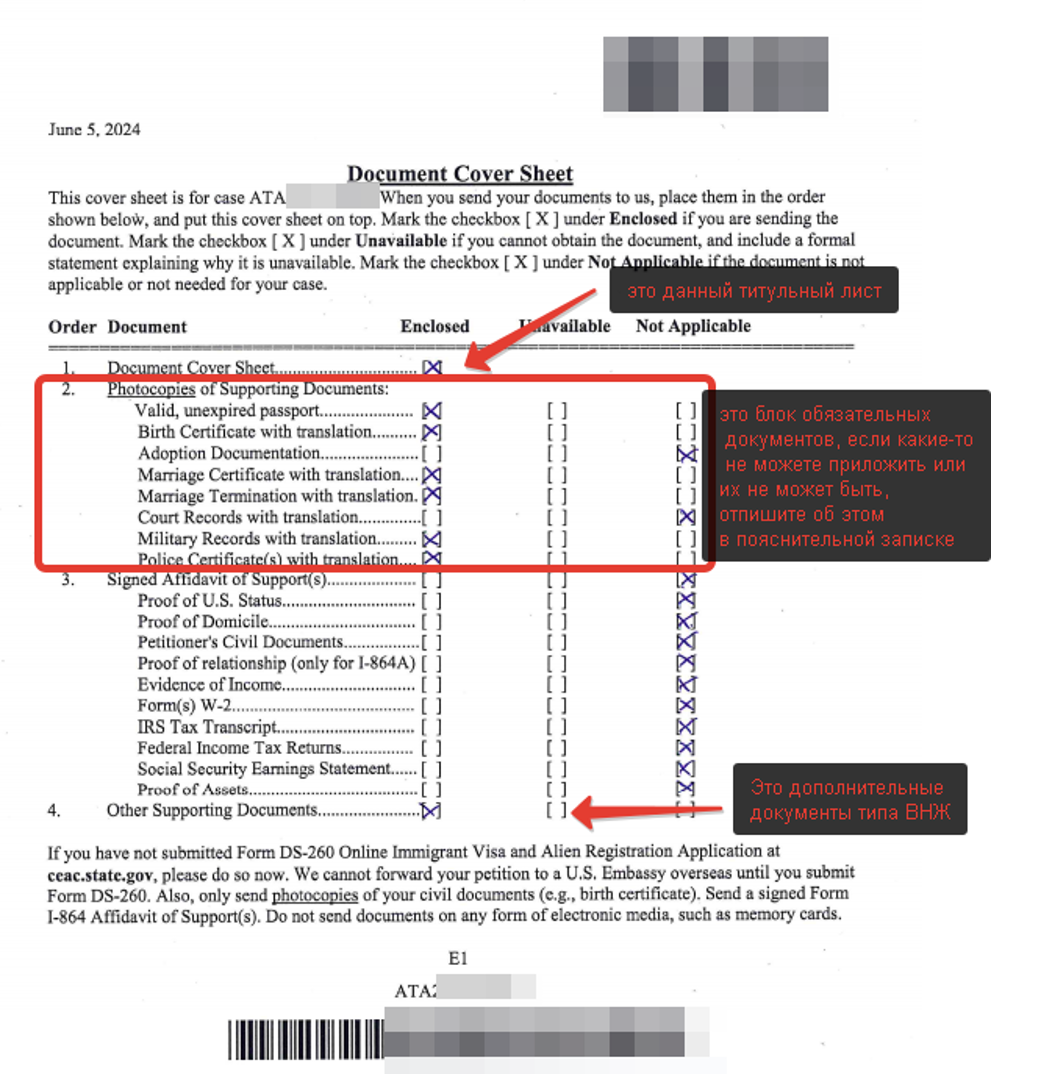
Sample cover sheet for a man, with documents attached
In the sample, these documents are marked:
- Valid, unexpired passport (the main page; no translation needed) - enclosed;
- Birth Certificate with translation - enclosed;
- Adoption Documentation (if you adopted a child or were adopted) - not applicable;
- Marriage Certificate with translation - enclosed;
- Marriage Termination with translation (the divorce certificate) - enclosed;
- Court Records with translation (if you were ever convicted) - not applicable;
- Military Records with translation (military service papers: the draft registration certificate, a service certificate or the military ID) - enclosed;
- Police Certificate(s) with translation (from each country the rules require, see the summary below) - enclosed;
- Other Supporting Documents - a work visa is enclosed. Section 3 of the sheet, the Affidavit of Support (Form I-864), is marked not applicable: an employment-based case needs it only when a relative who is a U.S. citizen or green card holder filed the I-140 or owns a significant share of the company that filed it.
Important:
Send only copies: scans in CEAC, or photocopies if NVC asked you to mail them. Do not send originals. Scan in high quality and check that everything is readable before you send it. Do translations the same way as for your petition: after each document, the translator adds a stamp with contact details and a signed statement that the translation is accurate and that the translator is competent to translate. You do not need a notary for the translations.
Do NVC documents have to be scanned and printed in color?
Yes. NVC's scanning instructions say every scan must be in color, so that all information, seals and signatures look as they do on the original. This helps NVC read the document and avoids delays caused by blurry or unreadable images.
When you scan, follow these rules:
- Scan both sides of a document if the back has stamps, notes or signatures.
- Make sure all text and images are readable and each page is the right way up, so nobody has to rotate it to read it.
Sample page order of a family's PDF package: the husband (principal applicant), the wife and one child
- Husband's cover sheet (principal applicant)
- Passport (only the main data page spread)
- Birth certificate, scan
- Birth certificate, translation
- Marriage certificate, scan
- Marriage certificate, translation
- Divorce certificate, scan (proof that each earlier marriage ended)
- Divorce certificate, translation
- Military ID, scan (scan every page, even blank ones)
- Military ID, translation (all pages)
- Police certificate, scan
- Police certificate, translation
- Other documents: work visa, scan
- Other documents: work visa, translation
- Cover letter about the documents that are not enclosed or do not exist.
- Wife's cover sheet
- Passport (only the main data page spread)
- Birth certificate, scan
- Birth certificate, translation
- Marriage certificate, scan
- Marriage certificate, translation
- Police certificate, scan
- Police certificate, translation
- Cover letter about the documents that are not enclosed or do not exist.
- Child's cover sheet
- Passport (only the main data page spread)
- Birth certificate, scan
- Birth certificate, translation
- Cover letter about the documents that are not enclosed or do not exist.
And so on: each family member gets a set of their own, and the sets go one after another into one full package for NVC. This order is for a package NVC asked you to mail. In CEAC you upload each document as a separate file, with its translation in the same file: PDF is preferred, up to 4 MB per file (Step 8 of the State Department instructions).
Important:
So that NVC does not lose any page of a mailed package, put the barcode and the case number on every scan and translation, and number all pages before printing, as "1 of 55".
Tip for a mailed package: Scan the documents, save them as PNG, then paste them into Word. Put the barcode with the case number in the document footer. If a scan fills the whole page, shrink it to make room for the footer. Put the translation and the translator's stamp on the next page. If the translation does not fit on one page, go on to the next one; that is fine. Each new document scan should start on a new page. Fill out the cover sheet by hand (mark the boxes with an X), then scan it. Sign the cover letter by hand too, then scan it. Number all the pages at the very end (in a corner, for example) and save the file as a Letter-size PDF. This avoids font problems when the package is printed in the U.S. and fits American printers.
Your steps once more, in short
- Collect the documents you need:
You will need a set of civil documents, such as:- A passport that stays valid for at least 60 days after your immigrant visa expires (22 CFR 42.64(b)). An immigrant visa is valid for up to 6 months.
- Birth certificate with a translation (if it is not in English).
- Marriage certificate and divorce certificate (if any), with translations.
- Police certificates with translations, if you are 16 or older: from your country of nationality (if you ever lived there more than 6 months), from your current country of residence (if you have lived there more than 6 months), from any other country where you lived 12 months or more after turning 16, and from any place where you were arrested. A police certificate is valid for two years from the date of issue, unless it comes from a country you used to live in and have not gone back to since (State Department rules).
- Military records (if you served), with a translation.
- Other documents (for example, a work visa or adoption papers, if they apply).
- Scans and translations:
Scan every document in good quality. Most cases, EB-1 and EB-2 NIW included, submit scans through CEAC, the State Department's online system. NVC asks for documents by mail or e-mail only when it tells you so by e-mail, phone or letter, usually for a case that is not processed electronically (Step 9 of the State Department instructions). Mail or e-mail documents only if NVC told you to; otherwise processing takes longer. - Sending documents to NVC by mail (only if NVC asked):
Address for regular USPS mail:DOS VisaP.O Box 65446Potomac Falls, VA 20165
Address for courier services (UPS, FedEx, DHL)
DOS Visa44132 Mercure CirclePO Box 65446Sterling VA 20166
The same addresses in a screenshot from the official site
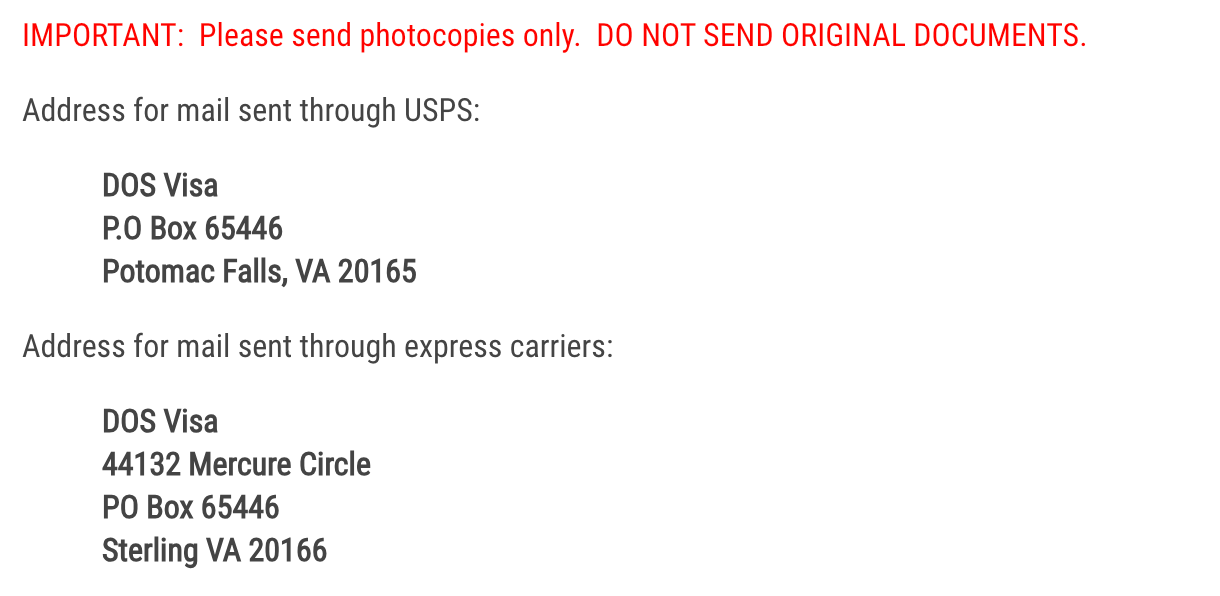
https://travel.state.gov/content/travel/en/us-visas/immigrate/submitting-documents-to-the-nvc.html
Send only copies of your civil documents, not the originals. Bring the originals to the interview.
- Documentarily complete ("DQ"):
NVC reviews your documents. When everything is accepted, the case is documentarily complete (applicants often say "DQ", documentarily qualified) and ready to go to the consulate. From this point NVC works with the embassy or consulate to schedule your interview.
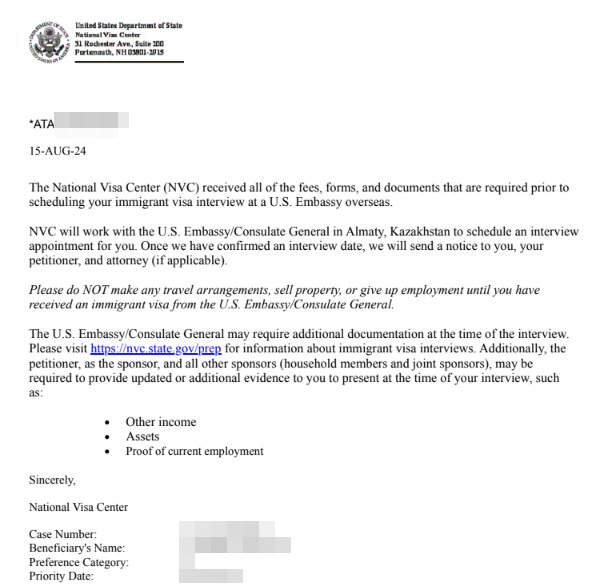
Letter from the National Visa Center: the case is documentarily complete (DQ)
Tips for a smooth submission
- Cover sheet: for a mailed package, fill out a cover sheet for each family member, marking the status of each document (for example, Enclosed or Not applicable).
- Translations and certification: every document that is not in English (or in the official language of the country where you apply) needs a certified translation, with the translator's signed statement that the translation is accurate and that the translator is competent to translate.
- Page numbers: in a mailed package, put the barcode and the case number on every scan and translation so the pages are easy to track. Number all pages before sending, as "1 of 55", so nothing gets lost.
- Changes in your case: if your family changes (for example, a child is born or you marry), tell NVC and send the supporting documents.
Sample translations in Word (documents from Russia and Kazakhstan)
Cover letter explaining why some required documents are missing for a person in the NVC package
Divorce certificate
Military ID
Draft registration certificate (Russia)
Birth certificate, new format
Birth certificate, old format
Marriage certificate
Police certificate (Kazakhstan)
Police certificate (Russia)
Still have questions?
NVC roadmap for applicants outside the U.S.: from approval to green card
Your I-140 is approved and you are outside the U.S. Here are the steps to take and the tools that help.
Tracking your case status
CEAC Visa Status Check (State Department: enter the case number from your NVC Welcome Letter)
USCIS Case Status Online (USCIS: enter the receipt number from your I-797 notice; useful until the case reaches NVC)
USCIS sends your case to NVC (applicants report from 6 days to 5 months)
If USCIS has not sent your case to NVC for more than 3 months and you paid for premium processing, write to the e-mail address printed on your Form I-907 receipt notice. Anyone can use the CIS Ombudsman's case assistance request (DHS Form 7001). You can also call USCIS if your case has not been sent to NVC for several months.
From the U.S.: +1-800-375-5283 From abroad: +1-212-620-3418 Applicants report that saying "InfoPass" skips the long recorded message.
Related pages
- Consular interview: 10+ real stories and how to prepare
- Consulates by country: 11 cities, the medical exam and what to expect (in Russian)
- 221(g) wait times: real 2023-2025 data by consulate (in Russian)
- Visa Bulletin 2026: EB-1 and EB-2 dates, what Current means
Questions and answers from readers
NVC sent three Welcome Letters in a row: is that normal before the consular interview?
Question: Is it normal that NVC sent me three Welcome Letters, 3-4 days apart? I sent all the documents they asked for, and almost two weeks later another letter came: "we have received your case, here is what you need to send us." Does this affect the timing or the date of my consular interview?
Reader's answer:
I moved my case from Abu Dhabi to Poland. It took three tries: the first two, to Kazakhstan, failed, and on the third try they approved the move to Warsaw. After the approval they sent a new case number starting with WRW (that's Warsaw). There was no separate welcome letter; I used the instructions from the first one.
Reader's answer:
We asked for a move from Warsaw to Yerevan through a lawyer, but NVC's reply still said the case was in Warsaw. We had to ask separately through their form whether the request had been accepted at all. Without that you can't tell whether it's just a standard letter or the move was refused.
Reader's answer:
My move to Almaty went through without a residence permit: we wrote to NVC that we could not get a visa to the EU, and they moved the case. But at the interview itself the consular officer asked about it directly: "Do I understand correctly that you went around the residence requirement?" So NVC approving a transfer and the actual interview are two different levels. NVC may let it through without residence documents, but the consular officer will look into it in person.
Reader's answer:
Those of you who had the interview in Warsaw: how long after NVC's letter with the interview date did a letter from the embassy come? Or is it not always sent? There seem to be several people here with a Warsaw case.
Reader's answer:
I have a Warsaw case too, but no letter from the embassy yet. I'm also waiting and don't know whether it always comes.
Reader's answer:
From my O-1 interview I remember 4 questions. That's standard: usually two to six, and it doesn't depend on the country of the embassy. It's rare for them to ask just one question and then refuse; that would be a warning sign. So if the officer was looking at the computer and talking to colleagues, it's most likely just the standard procedure, not a sign of a refusal.
Reader's answer:
In Yerevan the consul was a young American. When they took my documents, they asked right away which language I wanted for the interview, and I chose Russian. About the case itself there were 2 questions: what makes me extraordinary and how many years I have worked in my field. It was EB-1A. I was out in 10 minutes. So 2 questions are no reason to worry: the officer had simply gone through the case before I walked in.
Reader's answer:
I didn't know the embassy could send its own request for documents before the interview. I thought that once the I-140 is approved you just wait for the interview date. So they run their own check alongside NVC, and they may even ask for your academic supervisor's CV.
Reader's answer:
Two questions and 10 minutes in Yerevan for EB-1A is encouraging. Right now I'm sorting my documents by criteria into folders: judging, associations, publications, contribution. One question: does the officer pick one or two of them, or try to go through all six?
Reader's answer:
The officer definitely doesn't go through all six criteria one by one. In Belgrade, before the interview, they asked for the petition file and a CV in addition, so the officer had already studied the case before I walked in. They pick 1-2 points that seemed unclear and skip the rest.
Reader's answer:
In Warsaw, for an O-1, the officer didn't ask anything about the criteria at all. A very nice woman who spoke good Russian checked the documents and asked three questions: had I lived in another country, what is my mother's maiden name, and which language I wanted for the interview. About the case itself, not a word on specific achievements or criteria. So the picture is similar everywhere: the officer has already studied the case before you walk in, and at the window either clarifies 1-2 unclear points or doesn't go into the petition at all.
I-140 approved before June 22: does that mean I can file the DS-260 and wait for a consular interview?
Question: I want to check that I understand the order of steps. If the I-140 was approved before June 22, does that mean I can fill out the DS-260 and then just wait to be scheduled for the interview at a U.S. consulate? Or is there something else to do between these steps?
Reader's answer:
If you already have the I-140 approval, yes, the next step is the DS-260 (that's for people outside the U.S.). But between the DS-260 and the interview appointment there is one more stage: NVC gets the case, collects your documents, checks them and only then sends the case to the consulate. The waiting times are not fixed.
Reader's answer:
Oh, I somehow missed the NVC part; I thought the interview comes right after the DS-260. Can I start preparing documents for NVC in advance, or should I wait until they ask for them?
Reader's answer:
After you submit the DS-260, you follow the status in the CEAC portal. There is no separate "forms accepted" letter; you just see the case moving. I checked with my lawyer: at the end, once the visa is approved at the interview (see real interview stories), you simply enter the U.S. and the green card comes by mail.
Reader's answer:
A current priority date is the second condition, besides an approved I-140. My lawyer explained that NVC won't open the DS-260 until both conditions are met at the same time. So it's worth checking the visa bulletin every month in parallel.
Reader's answer:
One more point nobody mentioned here: you don't book the consular interview yourself; you wait to be called to the consulate named in the I-140. You can try to move the case to another country if you want, but that's a separate process. And about the risks of the consular route: you can't appeal a refusal there, unlike the I-485, where you can go to court after a denial. So the difference between the two routes is significant if you have a choice.
Reader's answer:
About the one-year period: there's no hard deadline, NVC doesn't close the case, it just waits until you submit the documents. But police certificates do expire: for the Warsaw consulate they must be no older than one year at the time of the interview. If you collect them too early, they may no longer be valid by the interview date, and you'll have to order new ones.
Editor's note: NVC does have a one-year rule. Under INA 203(g), if you do not apply within one year after NVC tells you a visa is available, the petition can be terminated and you lose its priority date (State Department). Until the case is documentarily complete, log in to CEAC, pay a fee or submit documents at least once a year. The State Department's general rule for police certificates is two years from the date of issue; check what your embassy asks for.
Reader's answer:
Entering on an immigrant visa is a bit different from a regular entry. The consulate gives you a sealed envelope; you hand it to the CBP officer at the border and must not open it yourself. After the check they put an I-551 stamp in your passport. It is temporary proof of status for one year, until the actual green card comes by mail. (Editor's note: the State Department's current after-the-interview instructions do not mention a sealed envelope; follow what your consulate tells you.)
This page is part of O1EB1, a free education program of Global Talent Foundation Inc., a 501(c)(3) nonprofit. Our mission is to help talented professionals understand the O-1, EB-1A and EB-2 NIW visas using official sources. We sell nothing and do not give legal advice. About O1EB1
Disclaimer
This is an independent analysis of public sources: laws, regulations and USCIS decisions.
It is not legal advice. The authors are not licensed US attorneys. Using this site does not create an attorney-client relationship.
Immigration policy changes. Check the current rules on uscis.gov and discuss your case with a licensed immigration attorney.